Landing a role as a medical assistant can feel daunting when you lack formal job history. However, a properly structured resume can showcase your academic training, clinical externships, and soft skills to prospective healthcare employers. This guide explains how to craft a compelling medical assistant resume that highlights your educational background and positions you as the ideal candidate for jobs after graduation.
Key Takeaways
- Highlight clinical externships and hands-on training as practical work experience.
- Emphasize essential soft skills like empathy, communication, and time management.
- Use a functional or hybrid resume format to focus on competencies rather than chronological job history.
- Clearly list your medical assistant certifications and specialized coursework.
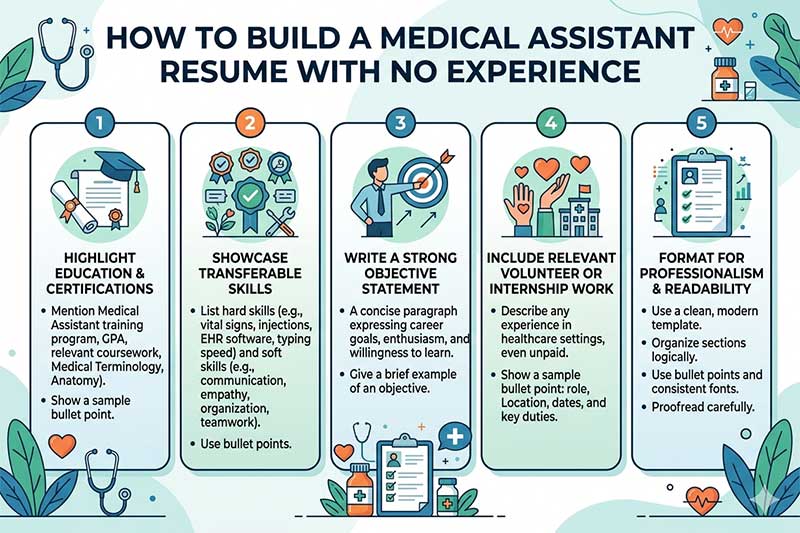
Discover 5 Steps to building a medical assistant resume
1. Prioritize Education and Certifications:
Since you lack direct work experience, highlight your academic achievements, relevant coursework (like medical terminology or anatomy), and any certifications you hold (such as a CMA or RMA). Place these prominently near the top of your resume.
2. Highlight Transferable Skills:
Identify and emphasize soft skills crucial for medical assistants, such as strong communication, organization, multitasking, and empathy. Also include technical skills you possess, like proficiency in specific software (e.g., EHR systems) or basic medical procedures you’ve learned.
3. Use a Strong Resume Objective:
Draft a concise and impactful objective statement at the beginning of your resume. Clearly express your enthusiasm for the medical assisting field and explain how your skills and education make you a strong candidate, despite not having direct experience.
4. Consider Volunteering or Internships:
If possible, gain relevant exposure through volunteer positions at clinics, hospitals, or nursing homes. Even short-term internships or clinical rotations can provide valuable practical experience and demonstrate your commitment to the field.
5. Format Your Resume Professionally:
Format Your Resume Professionally: Choose a clean and easily readable resume template. Organize the sections logically, using bullet points to present information clearly and concisely. Double-check for typos and grammatical errors, and ensure your contact information is correct and professional.
How do you format a medical assistant resume with no experience?
A functional or hybrid resume format is the best choice for entry-level medical assistants. This structure emphasizes skills, certifications, and academic training rather than chronological work history. When you have not yet held a paid position in a clinic or hospital, placing your relevant skills at the forefront prevents hiring managers from immediately noticing a lack of formal employment.
Choose the functional format if your primary focus is showcasing clinical competencies, such as taking vital signs or managing electronic health records (EHR). Choose a hybrid format if you have some unrelated work experience (like retail or customer service) that demonstrates strong transferable skills.
Which education details should you include on a medical assistant resume?
You should list your medical assistant diploma, relevant coursework, and any industry certifications prominently at the top of your resume. Since you lack formal employment history, your education is your strongest asset. Hiring managers want to see exactly what you learned during your program.
Detail specific classes and laboratories, such as anatomy, medical terminology, pharmacology, and medical billing. If you are still exploring specializations before finalizing your resume, read our Complete Guide to Different Types of Medical Assistants to tailor your coursework section for specific job applications. Additionally, explicitly state the name of your certification, such as Certified Medical Assistant (CMA) or Registered Medical Assistant (RMA), along with your certification number and expiration date.
How can clinical externships replace traditional work experience?
Clinical externships provide hands-on patient care experience and should be listed under a dedicated “Clinical Experience” or “Practicum” section on your resume. During an externship, students perform the exact duties required in a real clinical setting under the supervision of experienced professionals.
To make this section impactful, write bullet points detailing the specific tasks you completed. Examples include drawing blood, administering EKGs, sterilizing equipment, or updating patient charts. According to the Bureau of Labor Statistics (BLS), medical assistants routinely perform administrative and clinical tasks, which are precisely the duties you practice during a clinical externship. Treating your externship as a formal job on your resume proves to employers that you have actively applied your education in a real-world environment.
What soft skills are most important for medical assistants?
Empathy, active listening, and strong time management are the most critical soft skills for medical assistants to highlight on a resume. While hard clinical skills are necessary, employers highly value candidates who can communicate effectively with patients and multitask in a busy medical office.
Understanding Why Soft Skills Matter More Than Ever gives you a significant edge over other applicants who only list technical abilities. Patient interactions require patience and clear communication, especially when individuals are stressed or in pain. Furthermore, developing and showcasing 5 Essential Time Management Skills will make your resume stand out to clinic managers who need organized staff members to keep appointments running on schedule.
Taking the Next Steps Toward Your Medical Assisting Career
Writing a medical assistant resume with no experience requires a strategic focus on your education, externships, and soft skills. By organizing your resume to highlight your hands-on training and clinical competencies, you prove to hiring managers that you are ready to transition from a student to a capable healthcare professional. Review your coursework, detail your externship duties, and start applying for your first medical assistant position with confidence.
Frequently Asked Questions
What should I write in my objective for a medical assistant resume?
Your objective statement should be a brief, two-sentence summary that highlights your recent education, your relevant certifications, and your eagerness to contribute to a healthcare team. State the specific role you are seeking and emphasize your commitment to patient care.
Can I include non-medical jobs on my medical assistant resume?
Yes, you should include non-medical jobs if they highlight transferable skills. Roles in retail, hospitality, or customer service demonstrate your ability to communicate with the public, resolve conflicts, and work as part of a team.
How long should a medical assistant resume be?
An entry-level medical assistant resume should be exactly one page long. Keep the formatting clean and use concise bullet points to ensure hiring managers can quickly scan your educational background, clinical skills, and certifications.