Researching how to get your massage therapy license in California? California does not issue a statewide massage therapist license. Instead, the California Massage Therapy Council (CAMTC) offers voluntary certification, and some cities and counties require it.
This guide explains massage education, CAMTC certification and local requirements to consider before starting work. Passing the MBLEx is not currently required for CAMTC certification.
Key Takeaways
California offers voluntary CAMTC certification rather than a statewide massage therapist license.
CAMTC certification requires at least 500 hours of qualifying massage education.
New applicants pursue Certified Massage Therapist status; there is no 250-hour CAMTC student permit.
An approved examination is not currently required for CAMTC certification.
CAMTC certification renews every two years without a continuing education requirement.
What Is the Massage Therapy License, and Why Does It Matter?
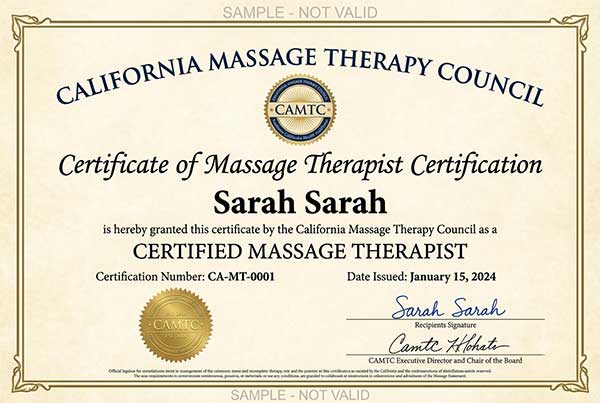
CAMTC is a nonprofit organization authorized under California law to certify massage professionals. Certification is voluntary under state law, although some cities and counties require it.
CAMTC certification allows an individual to provide massage for compensation throughout California without a separate local massage therapist permit. Business licensing and establishment requirements remain separate. Check the rules where you intend to work.
Step 1: Understand CAMTC Certification for New Applicants
New applicants apply for certification as a Certified Massage Therapist (CMT). CAMTC stopped accepting new applications for the former Certified Massage Practitioner (CMP) credential in 2015. That legacy category is not a temporary student permit after 250 hours of training.
Step 2: Complete an Approved Massage Therapy Training Program
CAMTC requires at least 500 hours of qualifying education, including at least 100 hours covering anatomy and physiology, contraindications, health and hygiene, and business and ethics.
What topics must your training cover?
Approved programs must include coursework in the following areas:
- Anatomy and physiology — musculoskeletal system, organ systems, and body mechanics
- Massage theory and technique — Swedish, deep tissue, and other modalities
- Pathology and contraindications — knowing when massage is or isn’t appropriate
- Business and ethics — professional conduct, scope of practice, and client communication
How long does massage therapy school take in California?
SOCHI’s Advanced Professional Massage Therapy program combines hybrid coursework with in-person practical training and student-clinic experience in North Hollywood. Its current program page lists 740 training hours over approximately 37 weeks, or nine months. Completion depends on the student’s schedule and academic progress. CAMTC application processing is separate from school completion.
Step 3: Understand Whether You Need the MBLEx
Passing the Massage and Bodywork Licensing Examination (MBLEx) is not currently required for CAMTC certification. If you intend to practice outside California, check that state’s licensing requirements before deciding whether to take an examination.
How should you prepare for the MBLEx?
- Study anatomy and physiology thoroughly—this content represents a significant portion of the exam
- Use FSMTB’s official candidate handbook for exam blueprints
- Take practice exams under timed conditions
- Review contraindications and pathology, which are frequently tested
Step 4: Complete a Background Check
CAMTC applicants must complete fingerprint-based background screening using CAMTC’s current Live Scan form and meet its background requirements.
All applicants must submit to a Live Scan fingerprint-based background check through the California Department of Justice and the FBI. This is a mandatory step—there are no exceptions.
The council reviews background check results on a case-by-case basis. A prior conviction does not automatically disqualify you, but certain offenses (particularly those involving sexual misconduct or fraud) can result in denial. If you have concerns, the CAMTC website provides guidance on the review process.
You can find authorized Live Scan locations through the California Attorney General’s website.
Step 5: Submit Your CAMTC Application
Once you’ve completed your training, passed your exam, and cleared your background check, you’re ready to apply for a massage therapy license or CAMTC certification. Here’s what the application typically requires:
- Completed CAMTC application form (submitted online)
- Official transcripts from your approved massage therapy school
- Live Scan background check results
- Application fee — check CAMTC’s current fee schedule.
- Government-issued photo ID
CAMTC advises allowing approximately 90 days for complete applications without background or education issues. Applications requiring additional review can take longer. Confirm that CAMTC has received the required documents before planning around an expected approval date.
Step 6: Meet Local Requirements in Your City or County
CAMTC certification and permission to operate a massage business are separate matters. Before opening a practice, ask the relevant city or county about business licensing, zoning and establishment requirements for your proposed location. If you are seeking employment, confirm the employer’s credential requirements.
How to Renew Your California Massage Therapy Certification
CAMTC certification is valid for two years. Certificate holders must apply for recertification and pay the applicable fee. CAMTC does not currently require continuing education hours for recertification.
Additional education may support professional development, but it should not be confused with a CAMTC renewal requirement.
Can You Transfer a Massage Therapy License from Another State to California?
California does not have formal reciprocity agreements with other states. Out-of-state therapists must still meet the council’s standard requirements, including:
- Proof of training hours (must meet CAMTC minimums)
- A California Live Scan background check
- A complete application and fee
If your prior training does not meet California’s hour requirements, you may need to complete additional coursework at an approved school before applying.
What Career Options Are Available After Getting Licensed?
A CAMTC certificate opens doors across multiple settings:
- Spas and wellness centers — including nationally recognized brands like Burke Williams and Massage Envy
- Chiropractic and physical therapy clinics — where massage therapists often work as part of integrated care teams
- Sports and athletic organizations — supporting recovery and performance
- Hospitals and rehabilitation centers — providing therapeutic massage to patients
- Private practice — building your own client base on your own schedule
Plan Your Massage Therapy Training
Planning a massage therapy career starts with understanding your education options and the requirements where you intend to work. School completion and professional certification are separate steps.
Explore SOCHI’s Advanced Professional Massage Therapy program and speak with Admissions about the current curriculum, schedules and practical training. Request program information or schedule a campus tour to learn more.
Frequently Asked Questions
Do I need a license to practice massage therapy in California?
California does not issue a statewide massage therapist license. CAMTC certification is voluntary under state law, but some local jurisdictions require it. Check where you intend to practice.
How many training hours are required for massage therapy certification in California?
CAMTC requires at least 500 hours of qualifying massage education. There is no current 250-hour CAMTC student permit for new applicants.
Which exam do I need to pass?
An approved examination is not currently required for CAMTC certification. Another state may require an examination for practice there.
How much does it cost to get CAMTC certified?
Check CAMTC’s current fee schedule. Fingerprinting and other expenses may be additional.
How long does it take to become a licensed massage therapist in California?
Timing depends on your training program and application review. SOCHI advertises approximately nine months of training; CAMTC processing is additional.
Can I work as a massage therapist while still in school?
Completing 250 hours does not provide a CAMTC student permit. Ask your school about supervised student-clinic participation and check local requirements before undertaking independent paid work.
Does California accept massage therapy licenses from other states?
Another state’s license does not automatically transfer. Contact CAMTC about its application and out-of-state education requirements.