Breaking into professional sports as a rehabilitation therapist is one of the most competitive—and rewarding—career paths in allied health. This guide covers everything you need to know: the qualifications teams look for, the day-to-day realities of the role, how to build the right experience, and the concrete steps you can take to land your first position in a professional sports organization.
Working with a pro sports team places you at the center of high-stakes athletic performance. You’ll be responsible for keeping elite athletes healthy, helping injured players recover as quickly and safely as possible, and collaborating daily with physicians, athletic trainers, and strength coaches. The environment is fast-paced and demanding—but for those who thrive under pressure and have a passion for sports medicine, it offers a career unlike any other in allied health.
Key Takeaways
- Rehabilitation therapists working with professional sports teams need a blend of clinical credentials, hands-on sports experience, and strong networking connections.
- Entry-level roles such as sports rehabilitation therapy aide or physical therapy aide are common starting points for breaking into professional sports environments.
- Building practical experience through internships, clinical rotations, and volunteer positions with amateur or collegiate teams is essential before pursuing pro-level roles.
- Certifications in sports-specific modalities—such as athletic training, massage therapy, or strength and conditioning—give candidates a measurable edge.
- Southern California is a high-opportunity market, home to multiple professional sports franchises across the NFL, NBA, MLB, MLS, and NHL.
What Does a Rehabilitation Therapist Do for a Professional Sports Team?
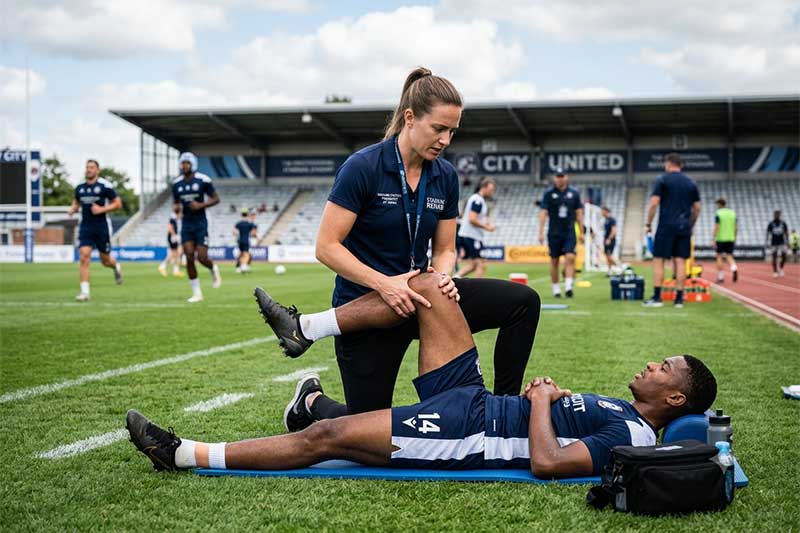
A rehabilitation therapist working with a professional sports team is responsible for preventing, assessing, and treating musculoskeletal injuries in athletes. The role sits at the intersection of clinical care and performance optimization. Unlike a traditional clinical setting, the pace is faster, the stakes are higher, and the pressure to return athletes to peak condition—quickly and safely—is constant.
Depending on the team’s size and structure, rehabilitation therapists may work under the supervision of team physicians and licensed physical therapists, or they may collaborate directly with athletic trainers and strength coaches. Core responsibilities typically include:
- Injury assessment and screening: Evaluating athletes before and after practice or competition
- Manual therapy and therapeutic exercise: Applying hands-on techniques and designing progressive rehab programs
- Post-surgical rehabilitation: Guiding athletes through structured recovery timelines following procedures like ACL reconstruction or rotator cuff repair
- Game-day support: Providing on-site treatment, taping, and injury management during live events
- Performance maintenance: Helping healthy athletes stay injury-free through preventative care and mobility work
The role demands both clinical precision and the ability to function under pressure. Professional athletes are high-profile patients with demanding schedules, and the rehabilitation team is expected to deliver results within tight windows.
What Qualifications Do You Need to Work with a Professional Sports Team?
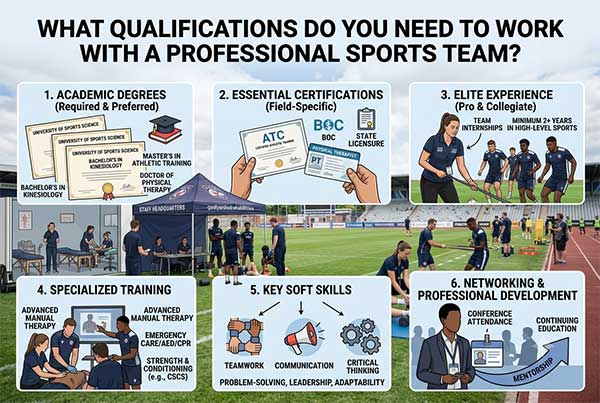
What education and credentials do sports rehabilitation therapists need?
The minimum educational requirement for most rehabilitation support roles in professional sports is an associate or bachelor’s degree in sports rehabilitation therapy, kinesiology, or a closely related field. Many roles specifically require—or prefer—candidates who have completed a sports rehabilitation therapy program that includes clinical coursework and hands-on training.
Key credentials that professional sports organizations look for include:
| Credential | Why It Matters |
|---|---|
| Associate Degree in Sports Rehabilitation Therapy | Foundational qualification for entry-level sports rehab roles |
| Certified Athletic Trainer (ATC) | Nationally recognized credential for sports injury management |
| Certified Strength and Conditioning Specialist (CSCS) | Demonstrates performance science knowledge |
| Licensed Massage Therapist (LMT) | Valued for soft tissue work and recovery support |
| CPR/AED Certification | Required for all on-field and game-day staff |
Beyond formal credentials, professional teams often require candidates to demonstrate experience with sports-specific populations. A strong academic record alone is rarely enough.
Do you need a license to work in sports rehabilitation in California?
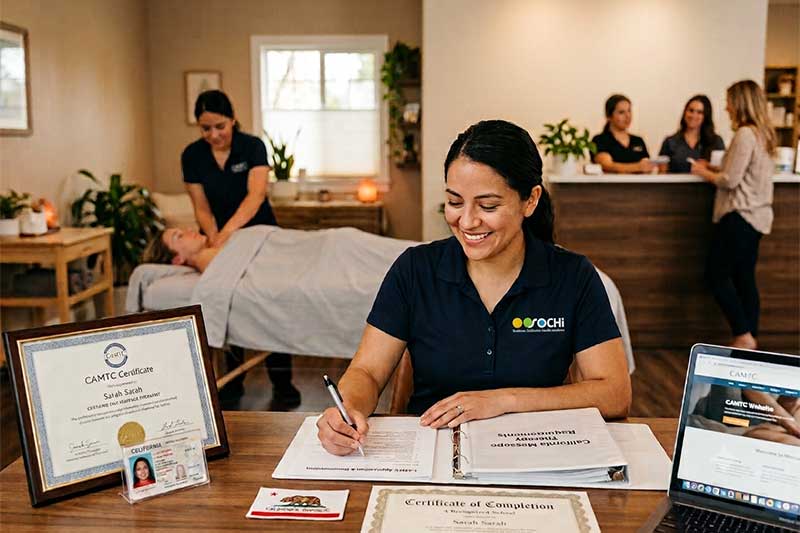
In California, scope of practice rules are strictly enforced. Rehabilitation therapists who perform physical therapy techniques must work under the supervision of a licensed physical therapist, unless they hold an independent license themselves. Massage therapists must comply with California’s CAMTC certification requirements. Anyone working in a direct patient care capacity should verify their role’s specific licensing requirements through the California Department of Consumer Affairs.
Staying compliant protects both the therapist and the athletes they serve.
How to Build Experience Before Applying to Professional Teams
How do you get experience in sports rehabilitation without a professional connection?
This is the most common challenge for aspiring sports rehabilitation therapists—and the most solvable. Professional sports organizations rarely hire candidates with zero sports-specific clinical experience. The path almost always runs through amateur, collegiate, or semi-professional sports first.
Practical ways to build relevant experience include:
- Volunteer with local sports programs: High school athletic programs, community sports leagues, and amateur clubs often welcome volunteers with healthcare training.
- Pursue clinical internships: Many sports rehabilitation therapy programs include externship placements with sports organizations. Choosing a program with strong clinical partner networks significantly accelerates this process.
- Seek positions with collegiate programs: NCAA programs regularly employ student athletic trainers and rehabilitation assistants. These roles offer direct exposure to competitive sports environments and professional-level protocols.
- Work with semi-professional or minor league teams: Organizations in the AHL, NAIA, or regional professional leagues are often more accessible to early-career candidates and provide real game-day experience.
- Network within the field: Attending sports medicine conferences, joining professional associations like the National Athletic Trainers’ Association (NATA), and connecting with practicing sports therapists can open doors that job boards never will.
Each of these experiences adds credibility to an application and demonstrates that a candidate understands the specific demands of athletic populations.
What Is the Day-to-Day Reality of Working with a Professional Sports Team?
What does a typical day look like for a sports rehabilitation therapist on a pro team?
The schedule is rarely predictable. Professional sports operate around season calendars, travel schedules, and the unpredictable nature of injury. A rehabilitation therapist on a pro team might start their day at 6:00 a.m. for pre-practice screening, spend the afternoon running post-practice recovery sessions, and then travel with the team for an away game that same evening.
A typical in-season day might look like this:
- Morning pre-practice assessment: Checking in with athletes who have active injuries or soreness flags from the previous session
- Practice coverage: Providing on-field or on-court support during training, with immediate response to acute injuries
- Post-practice treatment: Running individualized rehab sessions for athletes in different phases of recovery
- Documentation: Recording treatment notes, progress updates, and communication with team physicians
- Recovery modalities: Overseeing ice baths, compression therapy, or soft tissue work during the cooldown window
- Coordination with coaching staff: Communicating athlete readiness and return-to-play timelines
The off-season is comparatively quieter—but still active. Post-surgical rehab cases often peak in the months following the season, and pre-season screening demands ramp up quickly.
How to Stand Out as a Candidate for Sports Team Positions
What makes a rehabilitation therapist more competitive for a professional sports role?
Three things consistently differentiate successful candidates: specialization, relationships, and documentation of outcomes.
Specialization means developing deep competency in areas that professional sports teams specifically value. Injury prevention screening (such as the Functional Movement Screen), sports massage, instrument-assisted soft tissue mobilization (IASTM), and return-to-sport testing protocols are examples of skills that carry direct transferability to the pro environment.
Relationships are the currency of the sports medicine world. Many positions in professional sports are filled through referrals and word-of-mouth before they ever appear on a job board. Working with practicing sports medicine professionals, attending industry events, and staying connected to alumni networks from your training program all matter.
Documented outcomes set strong candidates apart. Keeping records of rehabilitation cases, tracking athlete recovery timelines, and being able to discuss clinical decision-making with specificity signals professional maturity to hiring managers.
For those based in Southern California, the regional job market is particularly strong. Los Angeles alone is home to the Lakers, Clippers, Rams, Chargers, Dodgers, Angels, Galaxy, Kings, and Ducks—making it one of the most concentrated professional sports markets in the country. According to the U.S. Bureau of Labor Statistics, employment of physical therapist aides and related roles is projected to grow 19% between 2023 and 2033, much faster than average across all occupations—and sports-specific roles are a significant driver of that demand.
How SOCHi's Sports Rehabilitation Program Prepares You for This Career
SOCHi’s Associate Degree in Sports Rehabilitation Therapy is specifically designed for students who want to work with athletic populations in competitive settings. The program covers injury prevention, therapeutic exercise, rehabilitation protocols, and manual therapy techniques—with training on the same equipment used in professional clinical settings.
Importantly, SOCHi has established clinical partnerships with organizations like Sports Rehab LA and MVMT WORX, giving students access to real-world placements that build the kind of practical experience professional sports teams expect to see. These connections are not incidental—they are built into the program’s structure, shortening the gap between graduation and employment.
For students interested in how the healthcare job market in Los Angeles is evolving, SOCHi’s guide to healthcare jobs in LA provides a useful overview of top employers and hiring trends across the region.
What Career Progression Looks Like in Professional Sports Rehabilitation
Starting as a rehabilitation therapy aide or assistant is the standard entry point for most professionals breaking into the sports industry. From there, career advancement typically follows one of two paths: clinical specialization or management.
- Clinical specialization: Pursuing advanced certifications in areas like sports nutrition, manual therapy, or biomechanical analysis to become an indispensable expert within a team’s medical staff
- Management and coordination: Moving into lead rehabilitation therapist or sports medicine coordinator roles, overseeing the full scope of athlete care and managing junior staff
Some therapists also transition into consulting roles, working across multiple teams or with sports performance companies. Others move into academic or education settings, training the next generation of sports rehabilitation professionals.
The key is to keep building credentials and experience throughout your career. The sports medicine field moves quickly, and the professionals who stay current with evidence-based practice and emerging technologies are the ones who advance.
Your Next Step Toward a Career in Sports Rehabilitation
Working with professional sports teams as a rehabilitation therapist is achievable—but it requires a deliberate, well-planned approach. The right education, the right clinical experience, and the right professional network are what separate candidates who land these roles from those who remain on the sidelines.
If you’re serious about this path, start by exploring what a well-rounded sports rehabilitation curriculum looks like and how it connects to real career outcomes. SOCHi’s blog post on choosing the right degree program is a useful resource for evaluating your options clearly before committing.
SOCHi’s Sports Rehabilitation Therapy program in the Los Angeles area is designed for exactly this career goal. With clinical partner placements, hands-on equipment training, and a curriculum built around real-world sports medicine demands, it provides the foundation to compete for roles at the highest level of the profession. Request program information today and take the first concrete step toward working on the sidelines of your sport.
Frequently Asked Questions
What degree do you need to work as a rehabilitation therapist with a professional sports team?
Most entry-level sports rehabilitation roles require at minimum an associate degree in sports rehabilitation therapy or a related field. Many professional teams prefer candidates who have additional certifications, such as Certified Athletic Trainer (ATC) or Certified Strength and Conditioning Specialist (CSCS), in addition to practical clinical experience with athletic populations.
How long does it take to become a sports rehabilitation therapist?
An associate degree in sports rehabilitation therapy typically takes approximately two years to complete. Some accelerated programs can be finished in less time. Additional certifications pursued after graduation add to the overall timeline, but many students begin accumulating sports-specific clinical experience during their program through internships and clinical placements.
Is sports rehabilitation therapy a good career in California?
Yes. California—and Los Angeles County in particular—is one of the strongest job markets in the country for sports rehabilitation professionals. The concentration of professional sports franchises, combined with a large recreational and amateur sports population, creates consistent demand. According to the U.S. Bureau of Labor Statistics, employment in physical therapist aide and related roles is projected to grow 19% through 2033.
How do you get your first job in professional sports rehabilitation?
Most professionals break in through volunteer work with amateur or collegiate teams, clinical internships during their training program, and networking within the sports medicine community. Positions in professional sports are highly competitive and are frequently filled through professional referrals. Building relationships early—while still in school—is one of the most effective strategies.
What is the difference between an athletic trainer and a sports rehabilitation therapist?
Athletic trainers are licensed healthcare professionals who specialize in the prevention, evaluation, and treatment of sports injuries, typically operating independently in their scope of practice. Sports rehabilitation therapists often work in a supportive clinical role, implementing treatment plans developed by licensed practitioners. The two roles are complementary and frequently work side-by-side within professional sports organizations.
Can you work with professional teams right out of school?
It is uncommon but not impossible. Most candidates need at least one to two years of relevant sports-specific clinical experience before professional teams consider their applications seriously. Starting with collegiate, semi-professional, or community sports programs after graduation is the most reliable path to eventually reaching the professional level.