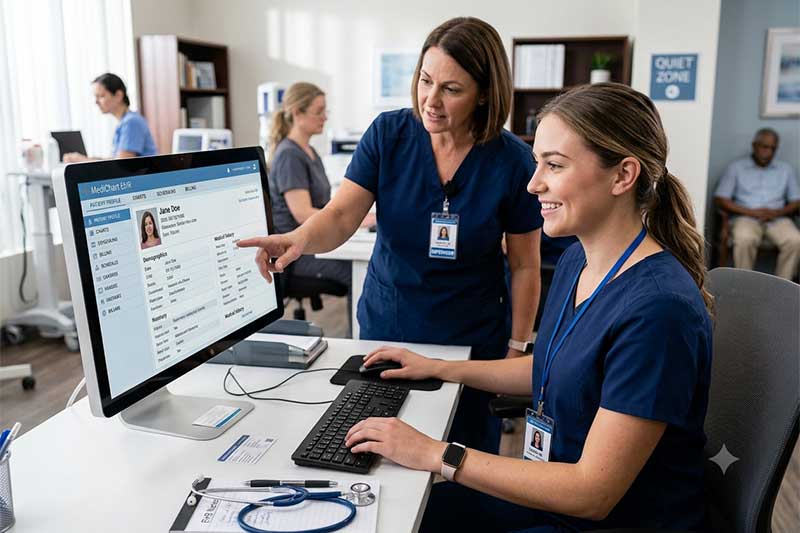
Electronic health records (EHRs) are now the backbone of modern clinical practice—and for new medical assistants, knowing how to use them isn’t optional. From documenting patient visits to coordinating care across departments, EHR competency directly affects patient safety, clinic efficiency, and your value as a healthcare professional. This guide breaks down everything you need to know about EHRs: what they are, how they work, why they matter, and how to build the skills that employers expect from day one.
Key Takeaways
- Electronic health records are digital versions of patient charts used across nearly all U.S. healthcare facilities.
- Medical assistants interact with EHRs daily to document vitals, schedule appointments, process orders, and support billing.
- HIPAA regulations govern how patient data in EHRs must be stored, accessed, and shared.
- Common EHR platforms include Epic, Cerner, and Meditech—each with its own interface but similar core functions.
- Hands-on EHR training during your medical assistant program gives you a significant competitive advantage when entering the job market.
What Are Electronic Health Records?
An electronic health record (EHR) is a real-time, digital version of a patient’s medical history. Unlike paper charts, EHRs are designed to be shared across multiple healthcare providers and settings—primary care offices, hospitals, specialists, labs, and pharmacies can all access the same record when authorized.
According to the Office of the National Coordinator for Health Information Technology (ONC), nearly 96% of non-federal acute care hospitals in the United States had adopted a certified EHR system as of recent reporting years. That near-universal adoption means that, regardless of where you work as a medical assistant, EHR proficiency will be expected.
EHR vs. EMR: What's the Difference?
These two terms are often used interchangeably, but they aren’t the same.
| Feature | EMR (Electronic Medical Record) | EHR (Electronic Health Record) |
|---|---|---|
| Scope | Single practice | Multiple providers and settings |
| Shareability | Not easily shared | Designed for interoperability |
| Patient access | Limited | Broader access via patient portals |
| Use case | Internal recordkeeping | Coordinated, whole-patient care |
An EMR is essentially a digital version of a paper chart used within a single clinic. An EHR goes further by enabling data exchange across the full continuum of care. Most modern facilities use EHR systems, not just EMRs.
Why Electronic Health Records Matter for Medical Assistants
Medical assistants are often the first clinical staff to interact with a patient’s digital chart during a visit. You’ll use the system to confirm demographics, record vitals, document the reason for the visit, and prepare the provider for the encounter. After the appointment, you may assist with follow-up orders, referrals, or billing documentation.
That makes accurate recordkeeping a patient safety issue, not just an administrative one. A wrong medication entry, an incorrect allergy notation, or a missed update to a patient’s problem list can directly affect clinical decisions. Beyond safety, efficient use of the platform keeps the clinic running on schedule—providers rely on medical assistants to have charts prepared, accurate, and complete before walking into the exam room.
What Do Medical Assistants Actually Do in an EHR?
The specific tasks vary by clinic and specialty, but most medical assistants regularly perform the following functions:
Patient Intake and Documentation
- Verifying and updating demographic information (name, address, insurance)
- Confirming the reason for today’s visit
- Reviewing and updating the medication list and allergy records
- Entering vital signs (blood pressure, heart rate, temperature, weight, oxygen saturation)
- Documenting the patient’s reported symptoms or chief complaint
Supporting the Provider
- Pulling up previous visit notes, lab results, and imaging reports
- Entering physician or provider orders (under supervision)
- Flagging abnormal results or outstanding referrals
- Preparing prescription refill requests for provider review
Administrative Functions
- Scheduling follow-up appointments directly within the EHR
- Generating referral documentation
- Supporting medical billing by ensuring visit codes and diagnoses are properly documented
- Responding to patient portal messages
Each of these tasks requires a working knowledge of how your facility’s system is organized—and the discipline to document accurately, every time.
The Most Common Platforms You'll Encounter
Not all electronic health record systems look or function the same. However, most follow a similar organizational structure once you understand the underlying logic. Here are the platforms most commonly used in U.S. healthcare settings:
| EHR Platform | Common Setting | Known For |
|---|---|---|
| Epic | Large hospitals, health systems | Robust functionality, patient portal (MyChart) |
| Cerner (Oracle Health) | Hospitals, multi-specialty groups | Interoperability, clinical decision support |
| Meditech | Community hospitals, critical access | Streamlined interface, strong pharmacy integration |
| Athenahealth | Outpatient clinics, private practices | Cloud-based, billing-focused tools |
| NextGen | Specialty practices | Specialty-specific templates |
Learning one platform thoroughly makes it significantly easier to adapt to others. The navigation differs, but the core concepts—patient charts, progress notes, orders, and scheduling—translate across systems.
HIPAA and EHR: What You Must Understand About Patient Privacy
The Health Insurance Portability and Accountability Act (HIPAA) sets the legal standards for protecting patient health information—and EHRs are squarely within its scope.
As a medical assistant, you are responsible for maintaining the privacy and security of any protected health information (PHI) you access. Violations can result in civil and criminal penalties, not just for the facility but potentially for you personally.
Key HIPAA Principles Every Medical Assistant Must Know
- Minimum necessary access: Only access information you need to do your job. Don’t look up records for patients who aren’t under your direct care.
- No unauthorized sharing: Patient data cannot be shared with family members, employers, or other providers without proper authorization or a legal exception.
- Secure login practices: Never share your EHR login credentials. Log out when stepping away from a workstation.
- Breach reporting: If you accidentally access the wrong record or notice a potential data breach, report it to your supervisor immediately. Prompt reporting is required by law.
For a deeper look at HIPAA requirements, the U.S. Department of Health and Human Services HIPAA resource center is the authoritative source.
Common EHR Documentation Mistakes New Medical Assistants Make
Accuracy is non-negotiable in clinical documentation. Here are the most frequent errors new medical assistants make—and how to avoid them:
- Copy-and-paste errors: Copying a previous note into a new visit without reviewing it can perpetuate outdated or incorrect information. Always verify before pasting.
- Incomplete vital signs: Leaving fields blank creates gaps that providers and auditors will flag. If a measurement wasn’t taken, document the reason.
- Using informal language: Clinical documentation must be objective and professional. Avoid phrases like “patient seems fine” in favor of specific, observable findings.
- Failing to save entries: Many EHRs don’t auto-save. Develop the habit of confirming that your entries have been saved before moving to the next task.
- Documenting before performing a task: Never chart that something was done until it actually has been. Pre-charting creates a legal and safety liability.
- Ignoring alerts: EHRs generate alerts for drug interactions, allergies, and overdue screenings. Dismissing these without reviewing them can put patients at risk.
Developing strong documentation habits early in your career will serve you throughout your time as a medical assistant—and make you far more effective in any clinical environment.
How EHRs Support the Full Patient Care Cycle
EHRs aren’t just for documentation during a visit. They support every stage of the patient experience.
Before the Appointment
The front desk and clinical staff use the electronic health record to confirm insurance eligibility, review outstanding orders, and prepare the chart. Medical assistants often review previous visit notes so they know what to expect when rooming the patient.
During the Visit
The medical assistant documents intake information, and the provider uses the EHR to review history, enter notes, place orders, and generate prescriptions. Real-time documentation keeps information current and reduces reliance on memory.
After the Visit
Follow-up tasks—lab orders, specialist referrals, post-visit instructions—are all managed through the EHR. Billing staff rely on the documentation to assign accurate procedure and diagnosis codes. Incomplete or vague notes directly affect how (and whether) the clinic gets reimbursed.
Understanding this full cycle helps you see why your role in the EHR extends well beyond typing in a few numbers.
EHR Skills That Will Set You Apart as a New Medical Assistant
Employers don’t just want someone who knows that EHRs exist. They want someone who can hit the ground running. The following skills will distinguish you from candidates with no hands-on EHR experience:
- Typing speed and accuracy: Most documentation is time-sensitive. A target of at least 35–40 words per minute with high accuracy is a practical baseline.
- Template navigation: Understanding how to use pre-built clinical templates (e.g., for annual exams, well-child visits, or specific chief complaints) dramatically speeds up documentation.
- Order entry fundamentals: Knowing the difference between a standing order, a PRN order, and a one-time order—and how to enter each—reduces errors.
- Patient portal communication: Many patients now contact their providers through the EHR’s patient portal. Responding to messages professionally and routing them to the right provider is increasingly part of the role.
- Basic troubleshooting: EHR systems occasionally freeze, log users out, or display error messages. Staying calm and knowing when to call IT versus when to restart the application is a practical skill.
If you’re still building your foundation as a medical assistant, the Complete Guide to Different Types of Medical Assistants on the SOCHi blog is a helpful starting point for understanding how the role varies by clinical setting—and how EHR responsibilities shift accordingly.
How Medical Assistant Training Programs Teach EHR Skills
Formal training programs, like the Medical Assistant diploma program at Southern California Health Institute (SOCHi), integrate EHR instruction alongside clinical and administrative coursework. Students practice documentation workflows, learn HIPAA compliance, and develop the habits that employers expect.
Real-world EHR training during your program is an advantage you can’t easily replicate on your own. Employers consistently report that candidates who arrive with hands-on EHR exposure require shorter onboarding periods and make fewer early documentation errors.
The pace and competitiveness of the healthcare job market in cities like Los Angeles make this preparation particularly important. The Healthcare Jobs in LA: Top Employers and Hiring Guide outlines what local employers look for—and EHR proficiency appears across nearly every listing.
Start Strong: Your Career Begins with the Right Foundation
Electronic health record systems are the central nervous system of modern healthcare. Every patient interaction, every clinical decision, and every billing transaction flows through them. For new medical assistants, developing competency early isn’t just good practice—it’s the professional standard.
Start by familiarizing yourself with how major platforms are organized, take HIPAA compliance seriously from your first day of training, and document with the mindset that every entry could inform a critical clinical decision. Those habits, built during your education, will carry you through every stage of your career.
If you’re ready to build these skills in a structured, hands-on environment, explore SOCHi’s Medical Assistant program. You’ll graduate with the technical knowledge, clinical confidence, and documentation experience that today’s healthcare employers are looking for. Request program information today and take the first concrete step toward a career that makes a difference.
Frequently Asked Questions
What is an electronic health record in simple terms?
An EHR is a secure, digital version of a patient’s medical history that can be accessed and updated by authorized healthcare providers across multiple settings. It typically includes medical history, diagnoses, medications, allergies, lab results, immunizations, and visit notes.
Do medical assistants need to know how to use EHR systems?
Yes. Proficiency with electronic health records is a core competency for medical assistants in virtually every clinical setting. Daily tasks—recording vitals, updating medication lists, scheduling appointments, and supporting billing—all require familiarity with the platform. Most employers expect new hires to have at least basic experience before their first shift.
What EHR system should I learn as a new medical assistant?
Epic is the most widely used platform in large hospital systems and health networks, making it a strong priority. However, learning the foundational concepts of any electronic health record—chart navigation, order entry, documentation workflows—makes it easier to adapt to whichever system an employer uses.
How does HIPAA apply to electronic health record use for medical assistants?
HIPAA requires medical assistants to access only the patient information necessary for their assigned duties, protect login credentials, avoid sharing patient data without authorization, and report any suspected breaches immediately. Violations can result in termination, fines, and in serious cases, criminal charges.
What's the difference between an EHR and an EMR?
An EMR is a digital record used within a single practice. An EHR is designed for broader use—it can be shared across different providers, specialties, and facilities. Most modern healthcare settings use EHR systems because they support coordinated, whole-patient care across multiple touchpoints.
How long does it take to become proficient in an EHR?
Most new medical assistants develop basic EHR proficiency within the first few weeks on the job, especially with prior training. Full confidence with a specific platform’s features—templates, order sets, patient portal management—typically takes two to three months of regular use.
Can I learn EHR systems before starting a medical assistant program?
Some vendors offer free or low-cost training resources. Epic, for example, provides free online learning modules through Epic UserWeb for individuals with access. However, structured training within a formal medical assistant program offers the most relevant, clinically contextualized preparation.